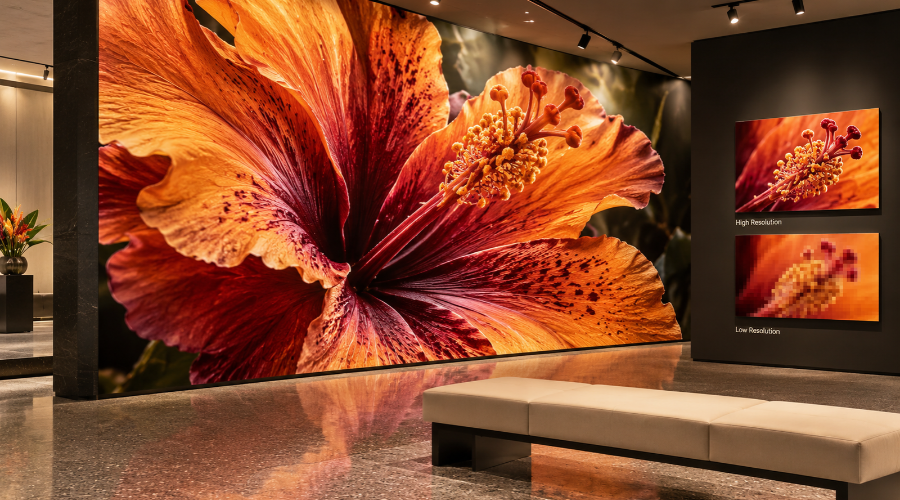
Recommended Image Resolution for Optimal Large Format Printing Quality
For environmental graphics, resolution depends on viewing distance, final size, surface, and content. We review each project around how people will see the graphic in the space. A wall mural viewed from across a lobby does not need the same file setup as a menu board viewed up close. Therefore, we focus on practical resolution, not just the highest number available.
In many cases, 100 to 150 dpi at final size works well for large wall graphics, barricades, dimensional displays, and event backdrops. For closer viewing, we may recommend 150 to 300 dpi at final size. However, extremely oversized files can slow production without improving what the viewer sees. We balance clarity, file performance, material behavior, and print method.
Vector artwork helps with logos, icons, patterns, maps, and typography because it can scale cleanly. Raster images need closer review, especially photography, textures, and detailed illustrations. As a result, we check effective resolution after scaling, not just the original file label. This helps us catch issues before print production begins.
When we prepare environmental graphics, we also review color mode, bleed, scale, and panel breaks. Resolution matters, but it does not work alone. For example, a sharp image can still print poorly if the file lacks proper bleed or uses low-quality compression. Our process looks at the full file, not one number.
Common Myths and Mistakes Around Resolution in Large Format Printing
Many file problems come from common assumptions. For instance, a file may show 300 dpi but still lack enough pixels for a ten-foot-wide graphic. The key question is how many pixels remain after the artwork reaches final size.
Another mistake involves enlarging small web images. Although software can add pixels, it cannot restore detail that never existed. This can create soft edges, noise, or visible artifacts. Instead, we prefer original photography, vector elements, or high-resolution source files.
- Do not rely on screen appearance as the only quality check.
- Do not place small images into oversized layouts without review.
- Do not flatten files too early when layered artwork may help edits.
- Do not ignore viewing distance when choosing a resolution target.
- Do not send final files without bleed, crop marks, and linked assets.
Sometimes, customers assume every large format project needs 300 dpi at full size. However, that can create files that become difficult to transfer, open, or process. More resolution does not always mean a better result. It matters most when the viewer stands close or when the artwork has fine detail.
We also watch for compression from email, screenshots, and presentation software. These shortcuts can reduce detail before anyone notices. Consequently, we ask for native design files or original image assets when possible.
Industry Standards and Source-Backed Guidance on the Best Resolution for Large Format Printing
Industry guidance generally connects resolution with viewing distance, output device, and final scale. Print organizations and software providers often recommend setting files based on effective resolution after enlargement. We follow that approach because it reflects how environmental graphics perform in real spaces.
For close-range graphics, such as interior signs, window displays, and wayfinding panels, higher effective resolution supports cleaner edges and image detail. Meanwhile, large murals, stadium graphics, and exterior banners can use lower resolution because viewers stand farther away. This approach keeps production efficient while maintaining the intended visual impact.
At Riot, we check files before production and flag concerns early. Then, we can recommend resizing, replacing images, rebuilding vector elements, or adjusting layout.
How Choosing the Best Resolution Enhances Visual Storytelling in Spaces
At Riot, we know that environmental graphics are more than just decorations – they are a core part of a space’s personality and purpose. Choosing the best resolution for large format printing directly influences the visual clarity and effectiveness of your graphics. When graphics are crisp and clear, information is easily communicated and the intended atmosphere is conveyed without distraction. This is especially important in high-traffic environments where viewers may see your graphics from both close-up and a distance.
Our approach focuses on making sure every detail – whether it’s brand colors, textures, or intricate imagery – translates to the finished product as intended. With the optimal resolution, your message stands out, supporting the storytelling and function of the space. This attention to detail helps foster a sense of connection and engagement in any environment where your graphics are displayed.
Practical Steps to Prepare Your Files for Large Format Printing Success
Getting the best results from large format printing begins with proper file preparation. Start by confirming the final size and viewing distance for your graphic. For most environmental graphics and grand format printing, images should be prepared at an effective resolution of 100–150 dpi at final size, as this balances image clarity with manageable file sizes. Ensure all images and graphics are converted to the correct color profiles (typically CMYK for print), and use lossless file formats like TIFF or high-quality PDF for best results.
Before submitting files, review them at actual print size whenever possible. Double-check design elements – such as logos and text – are vectorized if needed and verify that all fonts are outlined to avoid missing text or font substitutions. If you aren’t sure how to set your files up to meet the best resolution for large format printing, we’re here to help guide you at each step.
Partnering with Experts for Flawless Environmental Graphics and Large Format Results
Our team’s experience in large scale and grand format printing supports clients at every project stage – from reviewing concepts to delivering finished installations. We collaborate with you to ensure every graphic meets the needs of the environment and your expectations.
When you partner with Riot, you gain access not only to production resources but also to consultation on the best practices around file setup, resolution selection, and substrate choices. By investing in the right resolution and preparation up front, you can trust that your environmental graphics will achieve the clarity, impact, and longevity you need. Our goal is to ensure your visuals help define and enhance your spaces, capturing attention and leaving a lasting impression.
FAQ
What are environmental graphics and how do they impact spaces?
Environmental graphics are visual elements integrated into physical spaces to convey information, tell stories, or reinforce branding. When we bring graphics into an environment, we help shape the mood and functionality of a space, making it more engaging and intuitive for visitors. By using environmental graphics thoughtfully, we can transform ordinary spaces into immersive experiences that leave a lasting impact.
How does large format printing fit into environmental graphics?
Large format printing is a crucial tool for environmental graphics, as it enables us to produce graphics at a scale that can wrap walls, windows, floors, or even entire structures. Because these graphics are often seen from varying distances, large format printing allows us to deliver maximum visual impact. Through advanced technology and high-quality materials, we’re able to bring vibrant imagery and clear messaging into your environment.
Why does image resolution matter for large format printing projects?
Image resolution matters because it directly affects the clarity and professionalism of the final graphic. If we use images with insufficient resolution, your environmental graphics may appear blurry or pixelated, which can diminish their effectiveness. Therefore, selecting the right resolution ensures that your graphics look sharp and eye-catching, even when printed at large sizes.
What is the recommended resolution for large format printing?
For most large format printing, we recommend supplying artwork at a resolution between 100 and 150 DPI (dots per inch) at final print size. However, for graphics viewed from extremely close distances, it’s wise to use a higher resolution. Conversely, for installations viewed from farther away, a slightly lower resolution may still deliver excellent results. To ensure the best possible quality, we guide you through the optimal settings for your specific project.
Are there common myths about resolutions in large format printing?
Yes, there are several. One common myth is that higher resolution always means better quality. In reality, using extremely high resolutions can increase file size unnecessarily and slow down processing without visible gains, especially for graphics viewed from a distance. By focusing on the appropriate resolution for viewing distance, we make sure your graphics are both stunning and efficient to produce.
What are industry standards for large format image resolution?
Industry standards typically suggest 100 to 150 DPI at full print size for most large format applications, as referenced by professional organizations like SGIA and the Printing United Alliance. While these standards serve as a reliable baseline, factors such as material, lighting, and intended viewing distance may influence final recommendations. Our team always stays up to date with the latest guidelines to deliver exceptional results.
How can choosing the right resolution enhance visual storytelling?
Selecting the correct resolution ensures that every detail in an environmental graphic is sharp and vibrant, which enhances the overall narrative in your space. With the right choices, we help you create an immersive atmosphere that communicates your message powerfully. Moreover, crisp graphics convey professionalism and attention to detail, reinforcing your brand’s credibility and story.
What practical steps should I take to prepare my files for printing?
To prepare your files, ensure that your artwork is correctly sized at the intended dimensions and created at the recommended DPI. It’s essential to use high-quality source images and to outline or embed fonts. Additionally, flattening layers and converting files to CMYK color mode can help avoid unexpected printing issues. To make the process seamless, we’re always available to review your files and provide feedback before printing.
Can we help with optimizing low-resolution images for large format?
Absolutely! If your images are lower in resolution than ideal, we can often apply upscaling techniques, advanced software, or visual effects to improve their appearance. While we recommend using high-resolution originals whenever possible, our expertise enables us to maximize quality even when source imagery is less than perfect. Working closely with our team, you’ll gain the best possible outcome for your graphics.
Why should I partner with Riot for environmental graphics and printing?
By partnering with us, you gain access to industry-leading expertise, the latest technology, and an unwavering commitment to quality. We guide you through every step – from design to installation – ensuring your large format graphics make exactly the impact you envision. With our collaborative approach and dedication to flawless results, we make your environment unforgettable and your project smooth from start to finish.