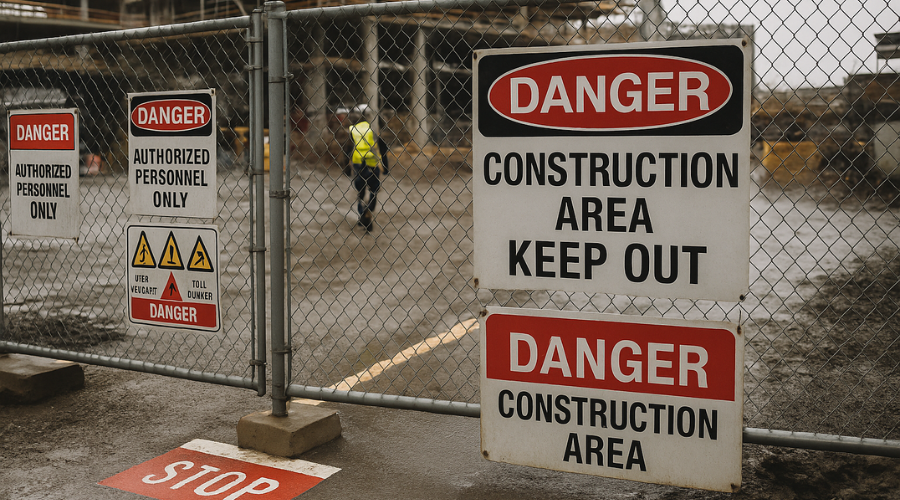
Understanding Contractor Signage and Its Impact
Contractor signage plays a pivotal role in the construction industry, serving as an intersection between environmental graphics and essential on – site communication. Our approach recognizes that beyond guiding and informing, these visuals embody the essence of our brand and are fundamental in crafting the narrative of our worksite. Their presence is a silent herald of our ethos and professionalism, setting the stage for the entire project.
The Significance of Contractor Signage for Branding and Safety
Recognizing the dual purpose of contractor signage reasserts its importance. We don’t just view these markers as placeholders for information; they’re integral to our brand’s visual identity and an assertive declaration of our commitment to safety. By marrying the regulatory standards set forth by OSHA with our bespoke branding elements, our signs perform the critical function of ensuring a secure work environment while continuously underscoring our professional image.
First Impressions Matter: The Visual Appeal of Contractor Signage
The aesthetics of our contractor signage can significantly influence the perception of our work. They are the first point of interaction for many stakeholders and visually articulate the standards we uphold. We consider the impact of first impressions in our designs, aiming to engender trust and convey a message of reliability. By prioritizing visual appeal, we set a tone of excellence and attention to detail that resonates throughout the tenure of our projects.
Design Essentials for Effective Contractor Signage
When we design signage for contractor sites, clarity and functionality remain at the forefront. It’s not just about catching the eye; our visuals must communicate the necessary information efficiently. We achieve this by focusing on legible fonts, appropriate sizing, and clear color contrast to ensure the text stands out against the background. While simplicity makes information easy to digest, consistent use of our brand elements strengthens identity without overshadowing essential details.
Because our signage endures tough environmental conditions, materials and construction methods are selected to maintain their integrity throughout the project’s lifecycle. We consult established industry practices to determine the best approaches and collaborate with experienced designers to develop an aesthetic that is both professional and approachable. Additionally, including pictograms or universally recognized symbols can break language barriers, making our communication accessible to everyone on site.
Furthermore, we take care to balance compliance requirements with creative touches. We never compromise legibility for aesthetics, yet we find ways to integrate the core elements of our branding into each sign. This helps to unify the look and feel of the project site, enhancing recognition for anyone engaging with our work areas.
Strategic Placement for Maximum Visibility and Compliance
Proper placement of contractor signage is crucial for safeguarding both visibility and adherence to regulations. To maximize the effectiveness, we assess each site for traffic flow, entry points, and potential hazards. Signage is positioned so that it remains visible to employees, visitors, and inspectors alike – never obscured by temporary structures or site activity.
Compliance is fundamental. We base our strategies on municipal codes and current zoning laws, ensuring we meet all necessary standards. It’s not just a matter of legality; following these regulations protects us from costly delays and maintains transparency with stakeholders. Transitioning between project phases, we continually review signage placement, adjusting as the dynamics on site evolve.
- Install signs at all mandated access points for visitor and worker orientation
- Regularly inspect for visibility obstructions caused by new equipment or materials
- Use reflective or illuminated signs in low – light zones for enhanced safety
- Document and archive all signage placements for future reference or audit
When local regulations shift or our projects expand, we adapt the positioning of our signs promptly. Staying up to date on evolving requirements and maintaining detailed records supports our accountability and ensures consistent messaging.
Innovative Materials and Techniques in Contractor Signage
Recent advances in sign production allow us to extend the lifespan and effectiveness of our contractor signage. For instance, we now consider eco – friendly substrates that resist weather and fading but leave a minimal environmental footprint. By partnering with reputable suppliers, we ensure our materials meet the performance standards necessary for outdoor construction sites.
Moreover, digital printing technologies grant us sharper graphics and more consistent color reproduction. These improvements present our branding in the best light, even when signs are exposed to challenging site conditions. We also benefit from adhesive innovations, making it possible to affix signs securely to a wide variety of surfaces, including fencing, scaffolding, and trailer exteriors.
Whenever possible, we incorporate QR codes or NFC technology onto our signage, allowing for instant site information access through mobile devices. This integration not only boosts efficiency in communication but also exemplifies our commitment to modern solutions within environmental graphics. As technology continues to evolve, we remain attentive to adopting processes that further advance communication and support project success.
The Future of Contractor Signage in Environmental Graphics
As we look ahead, the evolution of contractor signage remains firmly intertwined with the advancements in environmental graphics. We recognize that as industries evolve, so too must the tools we use to communicate and showcase our presence at construction sites. It is significant to stay abreast of technological innovations and design philosophies that have the potential to redefine the standards and applications of contractor signage within the industry. Our continuous exploration of new materials, digital integrations, and sustainability practices positions us to not only anticipate future trends but also to set them. We are determined to continue crafting signage solutions that align with the ever – changing landscape of construction and design.
Measuring the Success of Your Contractor Signage
For us, the true measure of success in contractor signage lies in the tangible outcomes it generates. From heightened brand awareness to improved safety compliance, the benefits should be clearly identifiable and quantifiable. We encourage clients to regularly review the performance of their signage through metrics like visibility analysis, durability assessments, and stakeholder surveys. Feedback is a pivotal part of our process, enabling us to refine our approach and deliver signage that not only meets but exceeds expectations. We believe in a data – driven strategy, leveraging insights to fine – tune and optimize the effectiveness of every sign we produce.
Wrapping Up: Best Practices Recap for Contractor Signage
In conclusion, maintaining the delicate balance between functional necessity and visual impact is at the heart of our approach to contractor signage. Throughout this article, we’ve revisited the best practices essential for successful construction graphics, recognizing the importance of clear messaging, strategic placement, and aesthetic harmony. Our commitment to excellence in contractor signage is unwavering, driven by innovative design, meticulous planning, and a thorough understanding of our clients’ needs. As we advance, we will continue to champion signage that not only informs and directs but also inspires and uplifts the fabric of the environments we help create.
FAQ
What exactly is contractor signage?
Contractor signage refers to the signs used at construction sites to identify the contractor, provide safety information, and sometimes advertise services. It is an integral part of environmental graphics which enhances the visual environment within a construction area through the use of branding and informative content.
How does contractor signage contribute to workplace safety?
Contractor signage plays a crucial role in workplace safety by providing necessary guidelines and warnings to workers and visitors. Additionally, signage is used to mark hazardous areas, indicate safety equipment locations, and provide directional guidance, all of which are vital for maintaining a safe construction environment.
Can contractor signage really influence first impressions?
Indeed, the design and quality of a contractor’s signage can significantly impact first impressions. As such, professional and aesthetically pleasing signage is known to instill trust and convey a sense of reliability, reflecting positively on the contractor’s reputation.
What are some key design elements for effective contractor signage?
Some essential design elements include clear typography, high – contrast color schemes, and the inclusion of a company’s logo to enhance brand recognition. Moreover, it is important to ensure that the signage is legible from a distance and succinctly conveys the intended message.
Where should contractor signage be placed for optimal impact?
Contractor signs should be strategically placed at site entrances, along fence lines, and in high traffic areas to ensure maximum visibility. Placement should also take into account regulatory compliance with local zoning laws and adhere to any municipal coding regulations.
What advances in materials are being used in contractor signage?
We are seeing innovations like weather – resistant materials and reflective finishes that contribute to the durability and visibility of signage. Advances in printing technology also allow for more intricate designs and long – lasting vibrant colors.
How does contractor signage fit into the broader scope of environmental graphics?
Contractor signage is a core component of environmental graphics, as it helps define the construction space aesthetically and informatively. It often integrates with the project’s overall design scheme, providing a cohesive and branded environment.
How can the success of contractor signage be measured?
Success can be measured through various means including feedback from site visitors, reduced safety incidents due to clear signage, and the degree to which the signs maintain their visual appeal and structural integrity over time. Such metrics provide valuable insights for continuous improvement.
What future trends can we expect in contractor signage?
We anticipate greater integration of technology in signage, including digital displays and QR codes for interactive experiences. There’s also a growing emphasis on sustainable materials and practices, aligning with environmental responsibility goals.
Could you summarize the best practices for contractor signage?
Best practices include designing for clarity and brand consistency, ensuring regulatory compliance, and using innovative materials for durability. Additionally, strategic placement and ongoing evaluation of the signage’s effectiveness are key to optimizing impact.